Working with HPOTerms
from pyhpo import Ontology

# initilize the Ontology
Ontology()

# Retrieve a term e.g. via its HPO-ID
term = Ontology.get_hpo_object('Scoliosis')

print(term)
#> HP:0002650 | Scoliosis

# Get information content from Term <--> Omim associations
term.information_content['omim']
#> 2.29

# Show how many genes are associated to the term
# (Note that this includes indirect associations, associations
# from children terms to genes.)
len(term.genes)
#> 1094

# Show how many Omim Diseases are associated to the term
# (Note that this includes indirect associations, associations
# from children terms to diseases.)
len(term.omim_diseases)
#> 844

# Get a list of all parent terms
for p in term.parents:
   print(p)
#> HP:0010674 | Abnormality of the curvature of the vertebral column

# Get a list of all children terms
for p in term.children:
   print(p)
"""
HP:0002944 | Thoracolumbar scoliosis
HP:0008458 | Progressive congenital scoliosis
HP:0100884 | Compensatory scoliosis
HP:0002944 | Thoracolumbar scoliosis
HP:0002751 | Kyphoscoliosis
"""
Phenotype similarity
Calculate the phenotype similarity between two patients
from pyhpo import Ontology, HPOSet

# initilize the Ontology
Ontology()

# Declare the clinical information of the patients
patient_1 = HPOSet.from_queries([
   'HP:0002943',
   'HP:0008458',
   'HP:0100884',
   'HP:0002944',
   'HP:0002751'
])

patient_2 = HPOSet.from_queries([
   'HP:0002650',
   'HP:0010674',
   'HP:0000925',
   'HP:0009121'
])

# and compare their similarity
patient_1.similarity(patient_2)
#> 0.7594183905785477

# use other similarity method
patient_1.similarity(patient_2, method="resnik")
#> 0.2345
Clustering of patients
The :class:pyhpo.stats.Linkage` class allows linkage analysis and clustering of patients based on their similarity.
In this example, we’re clustering 25 genes based on their associated phenotypes.
import pyhpo
from pyhpo import Ontology

# needed only for plotting the dendogram
import scipy
import matplotlib
%matplotlib inline


Ontology()

phenotypes = [] # List[HPOSet]
names = []      # List[str]

for gene in Ontology.genes[:25]:
   # It's best to calculate the linkage only based on phenotypes and exclude modifier terms
   phenotypes.append(gene.hpo_set().remove_modifier())
   names.append(gene.name)

# Cluster the diseases using default settings
lnk = pyhpo.stats.linkage(phenotypes)

# Print the dendogram using scipy and matplotlib
plt = scipy.cluster.hierarchy.dendrogram(lnk, labels=names)
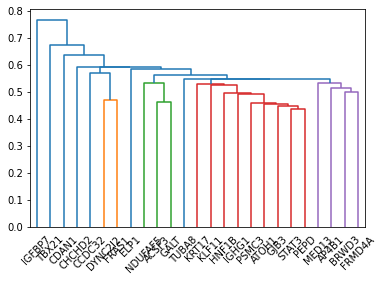
Example dendogram of 25 random genes
Gene-association enrichment
from pyhpo import stats, Ontology, HPOSet

# initilize the Ontology
Ontology()

# Declare the clinical information of the patients
patient_1 = HPOSet.from_queries([
   'HP:0002943',
   'HP:0008458',
   'HP:0100884',
   'HP:0002944',
   'HP:0002751'
])

# Calculate the enrichment of genes in an HPOSet
gene_model = stats.EnrichmentModel('gene')
genes = gene_model.enrichment(method='hypergeom', hposet=patient_1)

print(genes[0])
# >> {
# >>     'enrichment': 5.453829934109905e-05,
# >>     'fold': 33.67884615384615,
# >>     'count': 3,
# >>     'item': <Gene (PLOD1)>
# >> }
Multi-threading features
If you have lots of patients or other sets of terms and want to batchwise operations, you can benefit from hpo3 multiprocessing features
Calculate the pairwise similarity of the HPOSets from all genes
import itertools
from pyhpo import Ontology, HPOSet, helper

Ontology()

gene_sets = [g.hpo_set() for g in Ontology.genes]

# Create a list of tuples.
# Each tuple contains the two HPOSets to compare
# [
#     (HPOSet, HPOSet),
#     (HPOSet, HPOSet),
#     (HPOSet, HPOSet)
# ]
gene_set_combinations = [
   (a[0], a[1]) for a in itertools.combinations(gene_sets, 2)
]

similarities = helper.batch_set_similarity(
   gene_set_combinations[0:1000],  # only calculating for for 1000 comparisons to save time
   kind="omim",
   method="graphic",
   combine="funSimAvg"
)
# >> [
# >>     0.40744566917419434,
# >>     0.1365184634923935,
# >>     ...
# >> ]
Calculate the similarity of of a patient’s HPO term to all diseases
import itertools
from pyhpo import Ontology, HPOSet, helper

Ontology()

patient_1 = HPOSet.from_queries([
   'HP:0002943',
   'HP:0008458',
   'HP:0100884',
   'HP:0002944',
   'HP:0002751'
])

# casting the gene set to a list to main order for later lookups
genes = list(Ontology.genes)

# Create a list of tuples.
# Each tuple contains the patients HPOSet and the HPOSet of a gene
# [
#     (HPOSet_Patient, HPOSet_GeneA),
#     (HPOSet_Patient, HPOSet_GeneB),
#     (HPOSet_Patient, HPOSet_GeneC)
# ]
comparisons = [(patient_1, g.hpo_set()) for g in genes]

similarities = helper.batch_set_similarity(
   comparisons,
   kind="omim",
   method="graphic",
   combine="funSimAvg"
)

# Get most similar gene
top_score = max(similarities)
genes[similarities.index(top_score)]
# >> <Gene (POP1)>
Calculate the disease enrichment for large list of patients
If you have a large list of patients and want to find out which diseases are enriched in each of
them, use the pyhpo.helper.batch_omim_disease_enrichment() or
pyhpo.helper.batch_orpha_disease_enrichment() methods.
You can analyze hundreds of patients in seconds.
Note
For the below example we did not use the phenotypes of hundreds of patients.
Instead we mimic the type of data by converting genes to HPOSets.
Instead of gene_sets, you could also use a list of HPOSet with patient phenotypes
import itertools
from pyhpo import Ontology, helper

Ontology()

# casting the gene set to a list to main order for later lookups
genes = list(Ontology.genes)[:100]  # using only 100 genes in this example
gene_sets = [g.hpo_set() for g in genes]

enrichments = helper.batch_omim_disease_enrichment(gene_sets)
print(f"The most enriched disease for {genes[0]} is {enrichments[0][0]}")

# >> The most enriched disease for 730 | C7 is {
# >>     'enrichment': 3.6762699175625894e-42,
# >>     'fold': 972.9444444444443,
# >>     'count': 13,
# >>     'item': <OmimDisease (610102)>
# >> }
Calculate the gene enrichment for large list of patients
If you have a large list of patients and want to find out which genes are enriched in each of
them, use the pyhpo.helper.batch_gene_enrichment() method.
You can analyze hundreds of patients in seconds.
Note
For the below example we did not use the phenotypes of hundreds of patients.
Instead we mimic the type of data by converting diseases to HPOSets.
Instead of disease_sets, you could also use a list of HPOSet with patient phenotypes
import itertools
from pyhpo import Ontology, helper

Ontology()

# casting the gene set to a list to main order for later lookups
diseases = list(Ontology.omim_diseases)[:100]  # using only 100 diseases in this example
disease_sets = [d.hpo_set() for d in diseases]

enrichments = helper.batch_gene_enrichment(disease_sets)
print(f"The most enriched gene for {diseases[0]} is {enrichments[0][0]}")

# >> The most enriched gene for 619510 | Immunodeficiency 85 and autoimmunity is {
# >>     'enrichment': 7.207370728788139e-45,
# >>     'fold': 66.0867924528302,
# >>     'count': 24,
# >>     'item': <Gene (TOM1)>
# >> }